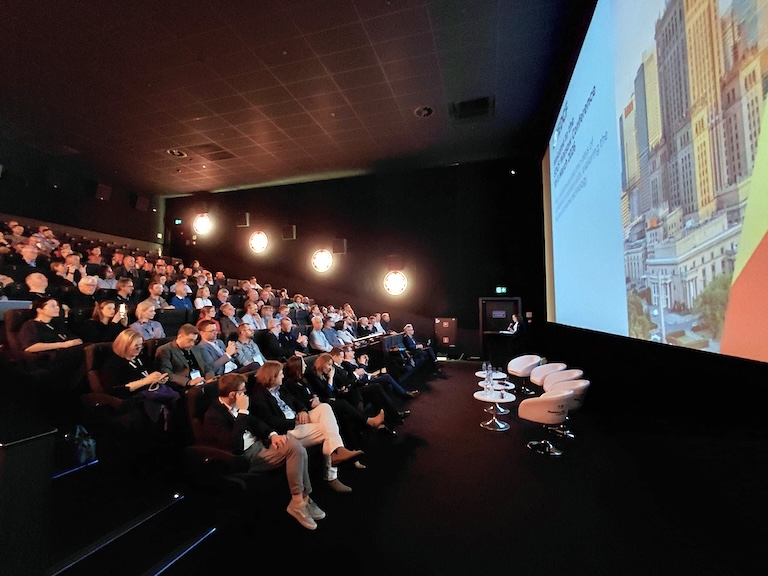
We have just wrapped up a highly successful edition of the EDCF Warsaw Conference, bringing together cinema professionals from across Europe for two days of presentations, discussions, networking and site visits across the Polish capital.
A huge thank you to everyone who contributed to making the event such a success, and especially to our Polish hosts, speakers, sponsors, and EDCF members for their support and active involvement throughout the programme.
Hosted on Tuesday 10 March at Multikino Złote Tarasy, and followed by an evening programme at Helios Blue City before venue visits on Wednesday morning to Kinoteka and Kino Iluzjon, this year’s conference put the spotlight on the variety and quality of cinematic experiences available in Warsaw.
A special thank you goes to our sponsors Helios, KD Kinotec, Dolby, Christie, Gofilex, LTI and Galalite, without whom this event would simply not have been possible.
The audience reflected the breadth of today’s cinema sector, with stakeholders representing the full film value chain. We welcomed a strong contingent of Polish operators, distributors and vendors, as well as exhibitors and industry professionals from across Europe, including a significant delegation from the Czech Republic.
The programme was designed to strike a balance between global trends, strategic market analysis, national case studies, cinema technology, accessibility, and audience experience. Judging by the feedback received throughout the two days, this balance resonated strongly with attendees and reflected the EDCF’s core mission: creating a platform where all parts of the industry can engage with both current challenges and future opportunities.
Opening the conversation in Warsaw
The conference officially opened with Opening remarks from Cathy Huis in ’t Veld Esser, President, EDCF, who welcomed attendees and set the tone for a day focused on collaboration, insight and exchange.
The EDCF was proud to host the conference programme at Multikino Złote Tarasy, with the support of Magdalena Lewicka, Mariusz Spisz and the wider local team, who ensured an excellent setting for the event in one of Warsaw’s best known cinema locations.
The opening keynote, Industry trends and market outlook, was delivered by Patrick von Sychowski, Vice-President, EDCF.
Patrick offered a broad and incisive overview of the forces currently shaping the cinema industry, from global studio consolidation and release strategy shifts to changing audience behaviours and the broader structural questions facing exhibition. It was an ideal way to open the conference, placing local and regional market and audience developments within a wider international context.
Spotlighting Polish cinema exhibition
The programme then moved into one of the day’s two central sessions, Polish cinema exhibition in a changing global landscape, moderated by Guillaume Branders, Executive Director, EDCF.
The panel brought together a strong line-up of speakers representing the Polish cinema ecosystem:
- Tomasz Jagiełło, Founder and Managing Director, Helios
- Oldrich Kubista, Director of Operations, Cinema City Poland
- Magdalena Lewicka, Management Board Member, Finance Director, Multikino, and President, Polish New Cinema Association
- Marlena Gabryszewska, CEO, Arthouse Cinemas Association Poland, and Vice-President, CICAE
The discussion explored why Poland has remained one of the more dynamic cinema markets in Europe at a time when many territories are still facing pressure on admissions and attendance. Panellists highlighted the importance of a strong and diverse national slate, growing audience engagement, innovative venue concepts, the resilience of the independent sector, and the continued value of showmanship and community-driven cinema experiences.
By hosting the conference in Warsaw, the EDCF was able not only to shine a light on a leading European market, but also to encourage valuable exchange between Polish professionals and colleagues from neighbouring countries and across the wider European cinema sector.
Regional perspectives from Czechia and Ukraine
That broader regional focus continued with Cinema industry trends in the Czech Republic, presented by Dan Krátký, Chairman, Czech Association of Cinema Operators.
Dan offered an insightful overview of a cinema market that is sometimes overlooked in wider European discussions, despite its strength and dynamism. His presentation highlighted the continued importance of local productions, innovative promotional strategies, and the value of audience research, including recent work on digital habits and audience behaviour. These insights were particularly relevant for national associations and cinema operators seeking to better understand changing expectations among cinemagoers.
The next session, Cinema in Ukraine: resilience and reality, was moderated by Patrick von Sychowski, Vice-President, EDCF.
This was one of the most powerful moments of the conference. With Roman Romanchuk, CEO, Multiplex Holding, joining in person and Natalia Baydan, CEO, Planeta Kino, contributing by phone, the session drew attention to the extraordinary resilience of the Ukrainian cinema sector and to the determination of cinema operators to continue serving audiences under extremely difficult conditions. It offered an inspiring reminder of cinema’s cultural and social role, and of the commitment of local professionals working to keep the big screen experience alive even in times of crisis.
The first half of the programme concluded with UNIC update on 2025 industry data and UNIC Technology Group activities, presented by Sonia Ragone, Industry Relations & Research Manager, UNIC.
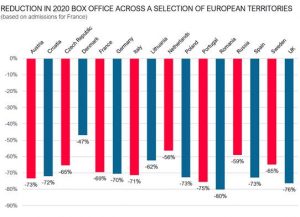
Sonia provided a timely overview of the latest European industry figures, emerging market dynamics, and the role of national titles in sustaining admissions across different territories. She also shared updates on the work of the UNIC Technology Group, helping connect broader industry data with the practical concerns and opportunities facing cinema operators and technology stakeholders.
Cinema technology at the heart of the afternoon
The second half of the conference shifted more directly into cinema technology, the core focus of the EDCF.
The first technical session was Rethinking cinema loudness metrics, presented by Julian Pinn, Managing Director, Julian Pinn Ltd.
Julian delivered one of the most technical presentations of the day, exploring long-standing frustrations around loudness in cinemas and examining how the language, standards and metrics used around sound measurement may need to evolve. The session generated strong engagement from the audience and reflected exactly the kind of informed technical dialogue the EDCF aims to encourage.
This was followed by an Update from the ICTA, delivered by Araceli Vaello, Internal Board of Directors Member, ICTA, (standing in for Jan Runge, who could sadly not be with us) and continuing the strong spirit of cooperation between the EDCF and its partners across the cinema technology community. ICTA also invited attendees to its upcoming event on 21 June 2026 in Barcelona, on the eve of CineEurope.
Next came Extended dynamic range in cinemas: where we stand, presented by David Hancock, Chief Analyst, Media & Entertainment, OMDIA, and featuring contributions from representatives of the three major manufacturers active in the field: Barco, Christie and Sharp (formerly NEC).
David offered a timely overview of developments in extended dynamic range presentation and the different approaches emerging across the market. His presentation helped frame the strategic and operational implications of these technologies as the sector continues to explore new ways of improving image quality and premium presentation standards.
Accessibility and audience experience
The next session brought an essential perspective to the programme. Accessibility: from principles to practice with Cinema Without Barriers was presented by Joanna Stankiewicz, Co-Leader, Project Development, Promotion & Accessibility, Cinema Without Barriers.
Joanna introduced attendees to the work of Cinema Without Barriers, a Polish initiative that has expanded into neighbouring markets and has become an important reference point in discussions around inclusive cinema. Her presentation combined practical insights with a broader reflection on accessibility needs, showing how both simple operational measures and more systemic approaches can make cinema more welcoming for all audiences.
The conference concluded with the second main panel of the afternoon, Designing the future cinemagoing experience, moderated by Alice Tentori, Sales Specialist, Digima.
The panel featured a diverse group of international speakers:
- Matt Basford, Head of Global Technology & Support Services, Regal Cineworld
- Sonia Ragone, Industry Relations & Research Manager, UNIC
- Marynia Gierat, CEO, Kino Pod Baranami
- Piotr Gierałtowski, Owner, Gieraltowski Architects, Extract Design
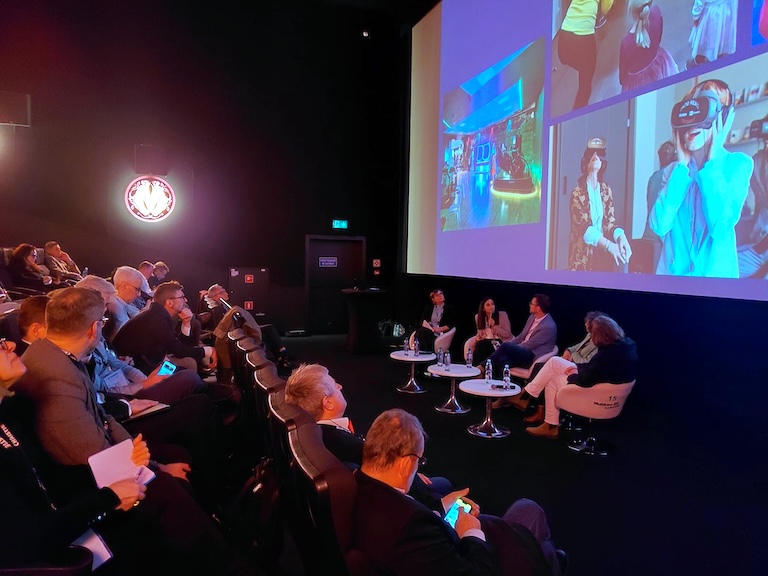
This final conversation brought together perspectives from exhibition, architecture, research and operations to explore how cinemas can continue evolving and experimenting in response to audience expectations. The panel touched on innovative venue concepts, the importance of hospitality and engagement, the expectations of younger audiences, and the many design choices that shape the cinemagoer journey from arrival to auditorium. A key focus was the need to retain and further attract Gen Z, which already represents a core and growing audience for cinemas. Delivering the kind of experiences these younger generations expect will be crucial to the future of the sector.
Together, these contributions underlined a shared belief across the industry: the future of cinema lies not only in content and technology, but also in the quality, coherence and distinctiveness of the overall experience.
An evening reception celebrating cinema showmanship
The conference programme was followed by an Evening reception and networking event at Helios Blue City, one of Warsaw’s best known multiplex venues.
Attendees were welcomed there by Tomasz Jagiełło, Founder and Managing Director, Helios, with the invaluable support of Bogumiła Grabowicz, Maria Vachev, Magdalena Zawadzka Okoń, and the wider Helios team.
The venue itself offered a fitting backdrop for the evening. With its bold design and striking interior atmosphere, Helios Blue City served as a strong example of the kind of distinctive cinema environment that can elevate the overall visitor experience. The evening programme reinforced the central themes of the conference by combining networking, hospitality and a strong sense of cinema identity in a way that reflected the Polish market’s particular strength in presentation and showmanship.
The reception itself was memorable in every respect. Guests were welcomed with cinema-themed cocktails, a generous dinner and a live musical programme that brought an additional layer of performance and theatricality to the evening, with songs performed by well known Polish artists and television stars Patricia Kazadi and Ania Karwan. More than simply entertainment, the event offered a vivid demonstration of the importance of showmanship in the cinema sector. It echoed many of the ideas discussed during the conference itself: that creating a memorable cinema experience goes far beyond projection and seating, and depends just as much on atmosphere, emotion, surprise and the ability to bring people together in a way that feels distinctive and shared.
Discovering two distinctive Warsaw venues
The second day of the conference programme focused on site visits, giving attendees the opportunity to explore two very different but equally significant and impressive cinemas in Warsaw.
The first stop was Kinoteka, where the group met for a guided visit inside the imposing Palace of Culture and Science. Kinoteka is one of Warsaw’s most distinctive cinema venues, combining historic grandeur with a lively and contemporary cultural identity.
The visit was hosted by Maria Majchrzak, who welcomed attendees with coffee coupled with Polish pastries and then guided them through the venue’s many spaces, from its bar and lobby areas to its screening rooms and larger halls. The visit offered valuable insights into the cinema’s history, architecture, positioning, and operational identity within the wider Warsaw market.
The second stop was Kino Iluzjon, one of the most iconic arthouse venues in Warsaw. The group was welcomed by Bartosz Pilecki and the team from Filmoteka Narodowa – Instytut Audiowizualny, which is responsible for Poland’s film archive and audio-visual legacy.
Kino Iluzjon offered a very different but equally compelling perspective on the role of cinemas in contemporary cultural life. As a venue closely linked to film heritage, cinephilia and institutional film culture, it provided attendees with a broader understanding of the diversity of exhibition models present within Warsaw. The conversation and guided visit gave participants the opportunity to learn more about the venue’s programming mission, audience profile and technical facilities, including its projection booth.
The morning concluded with a lavish lunch at Stolica Café, next to the cinema, offering everyone a final networking opportunity before bringing the programme to a close.
A strong reflection of the EDCF community
The EDCF Warsaw Conference was made possible by the active support of many partners, sponsors, hosts and members. Their contributions helped create a rich programme that moved fluently between industry strategy, national market analysis, technical discussion, accessibility, and cinema design.
It was also a strong reflection of what the EDCF seeks to be as a forum: a place where exhibitors, technology providers, analysts, architects, associations and cultural stakeholders can come together to exchange ideas, challenge assumptions, and collectively shape the future of cinema.
Warsaw proved to be an excellent host city for that conversation. The quality of the discussions, the diversity of speakers, and the character of the venues visited all contributed to a memorable and valuable edition of the conference.
We are proud to be part of such a committed and forward-looking community, and we look forward to building on this momentum at our upcoming events.
If you would like to attend future editions, please contact the EDCF.