The EDCF’s decision to host its annual conference in Warsaw proved more than symbolically apt. Poland is now one of the most instructive case studies in European exhibition and a reminder that cinema’s resilience is never automatic.
There is a particular pleasure in holding an industry conference in a city that actually has something to say. The EDCF Warsaw Conference, convened on 10 March at Multikino Złote Tarasy and continuing the following morning with site visits to two of the capital’s most distinctive historic cinema venues, was not simply a gathering of cinema professionals doing their annual rounds. It was a deliberate act of looking more carefully at a market that European exhibition too often overlooks – and finding, on closer inspection, that it has quite a lot to teach the rest of us.
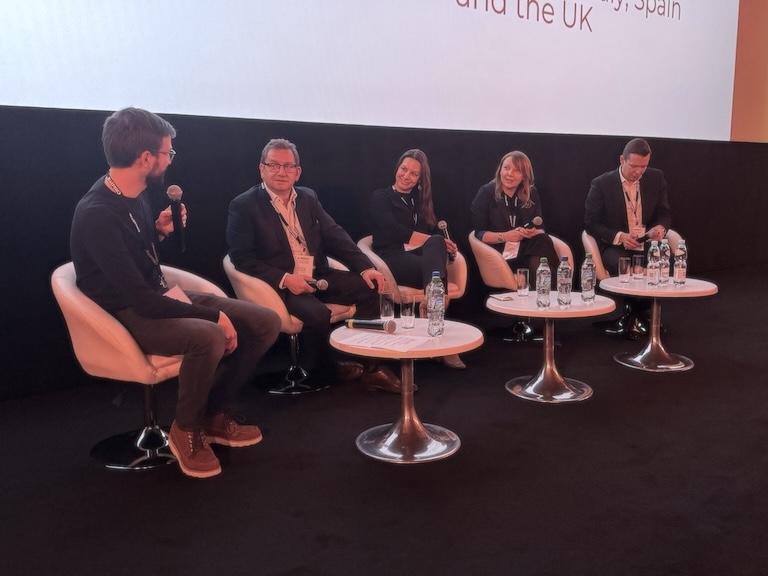
The centrepiece of the programme was the panel on Polish cinema exhibition in a changing global landscape, moderated by EDCF Executive Director Guillaume Branders. It brought together four panellists whose collective experience spans the full breadth of the Polish market: Tomasz Jagiełło of Helios, the country’s largest domestic multiplex operator; Oldřich Kubista of Cinema City Poland; Magdalena Lewicka of Multikino, also president of the Polish New Cinemas Association; and Marlena Gabryszewska, CEO of the Arthouse Cinemas Association Poland and Vice-President of CICAE. What followed was one of the more candid and substantive panel discussions heard at a European cinema event in some time.
The Numbers That Matter
The conversation started with the data, providing essential context for everything that followed. In Poland in 2025, box office revenues were up 1.3% and admissions increased 0.3%, with the local market share by box office estimated at 27%. Those numbers may not look dramatic in isolation, but set against the European backdrop they are genuinely noteworthy. Across the continent as a whole, cinema admissions fell 5.3% to 863.6 million in 2025, with box office declining 1% year-on-year. In 2024, Polish admissions had already surpassed the previous year, one of only a handful of European territories to record that improvement. Poland has now outperformed the European average for two consecutive years, in conditions that have been difficult for the industry globally. That consistency is worth interrogating, which is precisely what the panel set out to do.
The Legacy of Fifty Percent Growth
Lewicka offered the most historically grounded perspective of the session. Before the pandemic, Polish cinema admissions had grown by fifty percent over a decade – a figure worth sitting with, at a time when most Western European markets were either flat or in gentle decline. When the pandemic arrived, the fall was correspondingly severe.
“It hit us particularly hard here. We had just been on a train of incredible growth and incredible opportunities, and the whole industry – not only the cinema operators, but the whole film industry – was riding that wave. We are still, as an industry, catching up on capital expenditure and some investments that were deferred.”
Six years on, her assessment of where recovery actually stands was honest. Poland reached 51 million admissions in 2025, still roughly ten million short of the 2019 record. That gap, she argued, will not be closed without a stronger and more sustainable domestic slate. The recovery in international – and particularly family-oriented – content has been more robust than the local equivalent, and that imbalance matters for a market where national productions have historically been a major driver of frequency and loyalty.
The single word Lewicka reached for when characterising 2025 was telling: unpredictability.
“I don’t think any one of us predicted the top three films in the Polish market in 2025. With films like A Minecraft Movie and Dom Dobry, the most popular Polish production of the year, it’s about following the audience and the need to be super agile. I don’t think even the distributor of Minecraft, on the Friday of its opening weekend, envisaged what incredible results it would deliver.”
The "Coffee Machine Effect" and the Limits of Marketing
The panel’s most resonant concept came from Lewicka’s description of what she called the coffee-machine effect – and it cut to the heart of how audience behaviour has changed. The question cinema-goers increasingly ask, she suggested, is not which film to see this weekend, but which film is genuinely worth seeing in a cinema rather than waiting for at home.
“The question we get asked more and more often is not ‘which film is a good film to watch this weekend?’, but ‘which of the films opening this weekend is actually worth seeing in a cinema?’ When a film manages to capitalise on that – when everyone is talking about it – no marketing budget could manufacture that today. Dom Dobry succeeded because it brought the kind of authenticity that people are really looking for in cinema right now.”
Dom Dobry (Home Sweet Home), released by Warner Bros., was the most popular Polish film of 2025 with 2.4 million admissions. Three other local titles made the Polish top ten: In-Laws 3, a family comedy sequel; Kleks Academy 2, a young adult adventure film that sold nearly 1.2 million tickets; and Graduation Heist.
Jagiełło developed the same point from an operational angle, arguing that it requires a fundamental reframing of the cinema-going problem.
“People stopped going to the cinema every week. People go to see a specific movie or attend a specific event. The biggest challenge nowadays is how to properly spend the marketing budget – how to reach a sufficient number of customers to make them come. When you can create the buzz and the hype, people join. When you cannot, the collapse is much bigger than ten years ago.”
A Market Built Inside Shopping Centres
The discussion of screen density and future development produced one of the session’s more sobering moments of consensus. The Polish multiplex industry developed overwhelmingly inside shopping centres, tracking the rapid expansion of retail real estate from the late 1990s onwards. That expansion is now over.
“Shopping centres are no longer being built in Poland. Some of them are closing. It’s a correction – the market rejected the oldest and ugliest. The same is happening with cinemas. We are done, as an industry, with building new sites. All our energy must go into improving and guaranteeing the quality of what we already have.”
Jagiełło’s comments on premium formats carried the same unsentimental clarity. The logic of premium depends on scarcity: five percent of screens generating twenty percent of revenue works precisely because premium is not everywhere.
“You cannot make it so that all your auditoriums are premium, because then you lose the premium quality – it just becomes regular. Most people do not see the difference in picture quality, and ninety percent cannot hear the difference in sound. After thirty years of experience, I know that people are able to pay additional money for seats. Technology matters, but people are not ready to pay for technical quality. They are ready to pay for content, for experience, and for being part of a social community.”
The Arthouse Advantage
Gabryszewska’s contribution offered a useful counterpoint to the multiplex perspective. For arthouse and independent cinemas, the expansion of available catalogue – both contemporary international titles and classic Polish and international repertory – has created genuine programming flexibility.
“We have a huge catalogue of arthouse films right now, and also classic films – Polish classics and international classics – and this is the key for our audience. I totally agree that young people really love old films. If they are looking for something different, they go for the old films, not the new ones. From one side it is scary, but from the other side it is rather wonderful.”
The operational model, though, has shifted substantially.
“It is no longer the situation where we can screen three or four titles per week and have strong admissions. We need to create a lot of special events, a lot of meetings, a lot of additional activities to invite people. Cinema is no longer automatically the first choice. We have to convince them that cinema is an experience – not only the film, but a totally different experience from watching at home.”
Value Consciousness and Pricing Architecture
Kubista’s contribution on purchasing power and pricing was particularly instructive. Poland’s macro-economic trajectory has been strong and purchasing power is rising, but research from the Polish Film Institute confirms what operators already know from daily experience: Polish audiences remain significantly value-conscious, and headline ticket prices remain well below Western European comparators.
“The consumers in Poland are, I would say, very value-conscious. The headline prices of cinema tickets in Poland are undisputably way lower than in Western Europe.”
The response across the major operators has been sophisticated rather than simply deflationary.
“Each of the main players is using different pricing structures – advanced purchase discounts, zone pricing, more traditional discounts, promotions with commercial partners. These data-driven approaches to pricing structures are helping the market a lot. The option to visit cinema as part of a subscription – for people who want to come as often as they can for a flat fee – is another very important way to build a strong relationship with audiences and drive frequency of cinema-going, which is key for all of us.”
The WBD Question
No panel at a European cinema conference in early 2026 can avoid the question of what a Paramount–Warner Bros. Discovery merger would mean for the sector. The Warsaw panellists approached it with a mixture of professional discipline and barely concealed anxiety.
Jagiełło, speaking in part on behalf of UNIC, laid out the exhibition industry’s position with characteristic directness.
“What is important for us as an exhibition industry: we need movies. We need properly marketed movies with sufficient marketing budgets, and we need the window that allows us to secure our exclusivity. Cinema is the premium first-window format, and it needs exclusivity. There are only five studios left. We suffered when we lost one studio’s independence – Disney promised to keep the number of movies, and you know how that went. We do not find either transaction advantageous for our industry.”
His personal relief at Netflix’s withdrawal was unambiguous, if carefully distinguished from UNIC’s formal position.
“I am personally happy that Netflix withdrew, because a streaming platform owning a legacy studio runs directly counter to the core of our work. That calculation shows what it means in practice – probably layoffs – and from a content volume and marketing budget perspective, that is our biggest fear.”
Gabryszewska added the specific arthouse perspective, noting that for independent cinemas, the stakes are direct and operational.
“For us, the most important things are the theatrical window and accessibility to the films. The concentration of the market is always very dangerous. We will look very carefully at this transaction and focus on cinema safety and on access to the films.”
Both UNIC and CICAE, she confirmed, are committed to engaging actively with European competition authorities throughout any approval process.
What Warsaw Tells Us
The most valuable thing a well-chosen conference location can do is make abstract arguments concrete. Warsaw did exactly that. Poland’s combination of sustained market growth against a declining European average, a maturing local slate anchored by the remarkable performance of Dom Dobry, sophisticated pricing architecture, genuinely competitive arthouse provision, and operators thinking seriously about experience rather than just capacity – all of this makes it a more instructive model for the European industry than its profile might suggest.
The challenges are real too. The gap to 2019 remains open. Local production needs to be more consistently commercial. Audience behaviour is more volatile and less habitual than any operator is fully comfortable with. And the structural uncertainties around studio consolidation cast a shadow over everyone’s planning assumptions.
Kubista’s closing words captured the mood of the room well: the direction of travel is clear, even where the destination remains uncertain.
“We need to focus on bringing an experience to our customers that they cannot replicate at home – whether that is in the form of special formats, better seats, or special events. Our industry has always adapted, and we will keep adapting. I am cautiously optimistic.”
That cautious optimism – grounded in data, tested against genuine operational difficulty, honest about what remains unresolved – felt like the right note on which to leave Warsaw. The EDCF made a good call.
The EDCF Warsaw Conference was held at Multikino Złote Tarasy on 10 March 2026, with venue visits to Kinoteka and Kino Iluzjon on 11 March. Sponsors included Helios, KD Kinotec, Dolby, Christie, Gofilex, LTI and Galalite.